A Company That Was Nobody
On a maid's hundred guilders, non-human companies, and the strange optimism of letting everyone try
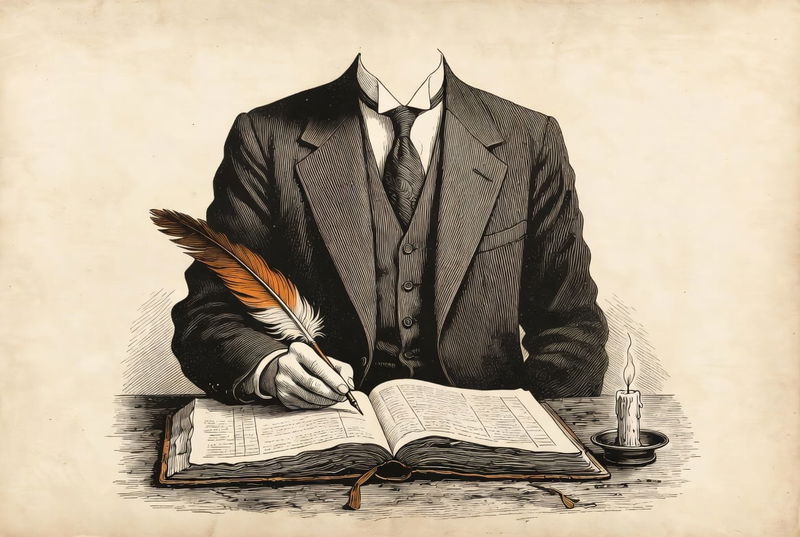
Last week, the president of Argentina used the Financial Times opinion page to propose a new legal category: corporations operated by AI agents. Companies with no human inside. Yuval Noah Harari read it and got worried, publicly; he called it an all-purpose key handed to machines, one that opens our financial, economic and political systems. The president replied by quoting Harari's own book back at him: humans have always used fictions to organize collective work.
I will not litigate Argentine politics, and whether the experiment works there is a decade away from an answer. Admire the government behind the proposal or despise it; ideas do not inherit the virtues or the sins of their messengers, and this one is older and bigger than any government. What interests me is the idea itself, because it might be the most hopeful economic story of the next fifty years.
To see why I'm optimistic, you have to go back to a merchant's living room in Amsterdam, and to the second-to-last name in a ledger.
The fiction that bent the curve
On the night of August 31, 1602, the book in that Amsterdam living room was about to close. For a month anyone had been able to walk in and sign it; the company's charter said so, in writing: all the residents of these lands may buy shares. No minimum, no maximum. The second-to-last name that night was Neeltgen Cornelis, the maid of the house: one hundred guilders, two hundred days of her wages. On the first page sat the directors, twelve thousand apiece, six canal houses each. Same book, same rules. The very last line belongs to the bookkeeper's own servant: the first shareholder registry in history (you can still leaf through it in the Dutch National Archives) closes with two housemaids.
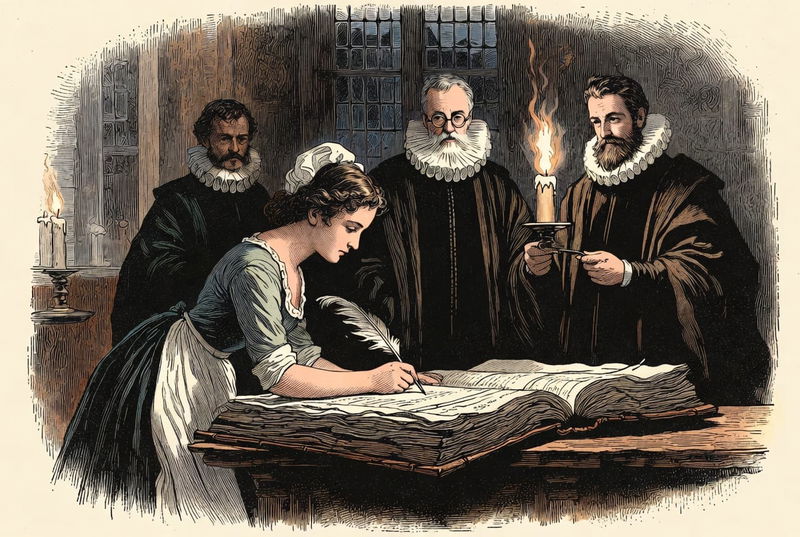
The book they signed created the Vereenigde Oostindische Compagnie, the Dutch East India Company, better known as the VOC: the first enterprise with permanent capital and shares that any stranger could buy and sell. It's hard to feel today how big a leap that was. Before the VOC, business was personal in the worst sense: if your venture sank (and ventures sank, often literally), your creditors took your house, your bed, and then your freedom. Debtors' prison was not a metaphor. Only two kinds of people started ventures, the rich, who could absorb the loss, and the desperate, who had nothing left to take.
The VOC's innovation fits in a sentence: you can only lose what you put in. That's the whole trick. A legal fiction: the company is a person, the person is liable, you are not. No engine, no chemistry, no physics. An agreement to pretend, enforced by courts. And that pretense changed who was allowed to try: a maid with a hundred guilders could own a piece of a voyage to the other side of the world. Risk became divisible. Trying became survivable.
Now hold that next to the oldest fact about our species. For most of human history, poverty wasn't a problem; it was the condition. Somewhere between three-quarters and nearly nine in ten of the people alive in 1820 lived in extreme poverty, and 1820 was not an unusually bad year; it was the peak of everything that came before. GDP per capita was a flat line for millennia.
Then, in roughly one century, the line went vertical.
Part of what happened: the nineteenth century did to the corporate fiction what Gutenberg did to the book. It made it cheap. Incorporating had taken an act of Parliament or a royal charter, which in practice meant friends in velvet rooms. Then the windows began to open, one jurisdiction at a time: New York first, in 1811, for manufacturers; most American states by mid-century; Britain in 1855, when the Limited Liability Act turned incorporation into a form you filled out at a window; France and Germany within fifteen years. What followed was the largest escape from poverty in the history of the species: from the overwhelming majority of humanity to under ten percent today. Deirdre McCloskey calls it the Great Enrichment and credits permission over capital, empire, or coal: ordinary people, finally allowed to have a go. History is never that tidy; we ran the experiment once, at full scale, with no control group, so take the attribution with the grain of salt it deserves. What came out the other side was the modern world.
Centuries after that midnight in Amsterdam, Nicholas Murray Butler, then president of Columbia University, told a New York audience that he weighed his words when he called the limited liability corporation the greatest single discovery of modern times: greater, he insisted, than steam or electricity, which would be reduced to comparative impotence without it. That was 1911, with the curve in full vertical. I used to find the line excessive. I no longer do.
Steam and electricity gave us power. The fiction gave us permission.
An empty suit that actually works
In my last piece I argued that the org chart is a fossil, the petrified imprint of one dead fact: skilled execution could only be bought from human beings, which made it scarce and expensive. It still is; what died is the "only." Meanwhile, the corporate suit has been quietly emptying for twenty years. The world's largest taxi company owns no cars, the largest hotelier owns no rooms, the largest media company creates no content. Each time something walked out of the building, the company got more valuable. The last thing still inside the suit is people.
Remove them, let agents execute, and what’s left is the suit itself: four centuries of corporate law, an exoskeleton built around soft human bodies. Employees to hire, officers to sign, humans to be negligent. Armor shaped for a creature that’s no longer inside.
The proposal simply refits the armor, with one non-negotiable clause: accountability must end in a human name on file with the registry. Not a boss; the entity runs itself, and most failures should be caught the way platforms catch bad actors today, in layers: the charter's own rules first, the professionals who sign off on its judgment next, insurance and the market after that. The registry exists for the residue, the harm no layer caught, so that the question of who answers always has a final answer. Owner is the lawyers' word for that name, but a founder, a cooperative, a nonprofit all qualify; the clause was never about who gets rich, only about where the chain ends. Not published to the world, any more than your bank account is. A shell, not a soul. Same move, third time.
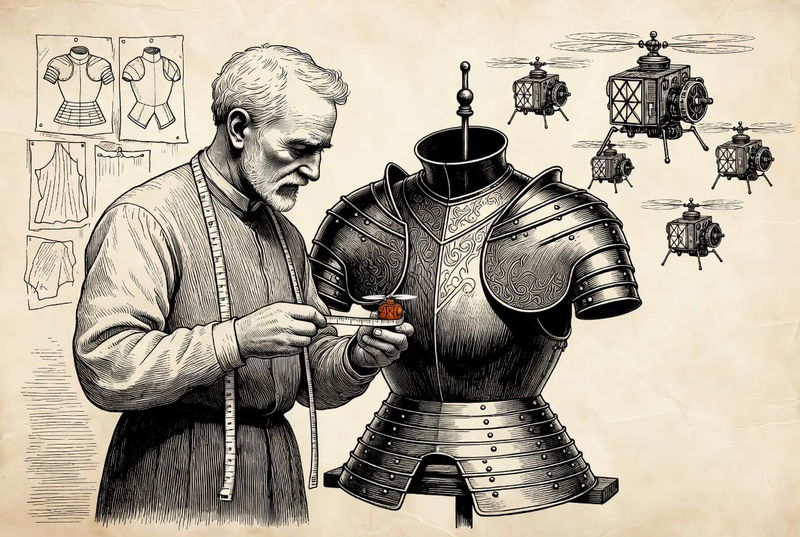
Legally, of course, this is still science fiction: no law on the books will charter an entity with no humans inside. That gap is what the proposal closes, and notice what kind of gap it is: every other piece already runs somewhere in production. The execution? Agents are taking over the daily plumbing of companies, the invoices, the payments, the scheduling: slowly, unevenly, and faster every quarter. Deploying AI systems inside large enterprises is my day job, so I get to watch the front line move weekly. The governance? A company's bylaws can be code that enforces itself, and the DAOs (strip away the casino that grew around them) spent a decade proving it with real money.
What the DAOs never got was a shell that fit: when a US judge finally had to classify one, the closest legal box was a general partnership, the one form with no liability shield, where every member answers with their house. The president's piece cites that very ruling, and reads it the same way: precisely the wrong architecture for what comes next. The bleeding edge of 2023, running the legal exposure of 1601. Engine, no chassis; the new corporate form is the chassis.
And the running costs? They bend toward a rounding error. Yes, today's frontier prices are partly investor money on fire, and billed at true compute cost they would be higher; that objection is fair. But the floor of the market is not subsidized: free-to-download models on hardware you own, paid for in electricity, better with every release. I tune mine on the laptop I'm typing this on. A bubble can reprice everything above that floor. It cannot reprice the floor.
Execution, governance, costs. What that list leaves out is judgment, and here is the quiet novelty: judgment doesn't have to be on payroll. The entity can buy it the way companies already buy auditing or outside counsel: a professional on retainer who decides the edge cases, certifies what the agents may act on (disclosure: building that layer is my own nights-and-weekends project), and signs the call. The signature is the point: not advice, liability. Arthur Andersen signed Enron's numbers, shredded the evidence, and was dead within a year anyway; the death penalty is what makes a signature worth anything. The new form keeps the penalty and removes the shredder: every certified call is on the record, replayable in court, because the ledger is the product. You cannot shred the thing you sell. These companies don't remove humans from the economy. They open a new market for the one thing no model upgrade will ever supply: judgment that signs its name.
So: can a company with nobody inside actually run? The boring technical answer is yes. What's left standing isn't a technical objection. It's fear. And the fear, unlike the technology, is not new; it comes with a long paper trail.
The same fears, word for word
If the idea alarms you, you’re in excellent historical company.
When limited liability was debated in the 1800s, critics said it would let the wealthy gamble with other people's money: offer up a portion of their excesses and let poor deceived creditors devour the bait. That's an 1824 complaint, nearly verbatim, the same pamphlet the president quotes in his proposal. A tool of elites. A dissolution of responsibility. Speculative chaos unleashed.
What gets me about those objections is that every one sounded reasonable, and every one described the world exactly as it stood on the eve of the reform, which is to say, the world the reform abolished. Incorporation was elitist, back when it required kneeling before Parliament. The reform the critics feared ended the elitism they were describing. They mistook the photograph for the film.
The 2026 objections read like the same script with new nouns. Only the tech elite will own these entities. Sure, today, while the door is narrow. That’s the photograph. Launching an internet company cost about five million dollars in 2000 and about five thousand a decade later, and the result was not fewer founders but orders of magnitude more, on every continent. I can't prove the pattern repeats. I can say it has repeated every previous time, and the burden of proof sits with whoever claims this collapse in the cost of trying will be the first in history to narrow the base.
Two objections, though, are genuinely new. First: the models these entities run on are controlled by a handful of companies. True today, and worth worrying about. My honest answer is that the remedy is competition at the model layer, not prohibition at the company layer: open-weight models are already loose in the world, and we've watched this movie with electricity, which also began as a few power stations and ended as a commodity nobody thinks about. I might be wrong about how fast the model layer opens up. I don't think I'm wrong about which layer the problem lives in.
Second: the chain of accountability. This one is real: it's the hill the whole project lives or dies on. Harari has earned a serious reply, and I'll get to it.
What the Luddites actually wanted
There's one more historical witness to call, and he can't be filed under fear, because his grievance was real.
History remembers the Luddites as the people who hated machines, which is almost exactly backwards. The men who broke stocking frames in 1811 had worked those frames for generations, and they smashed selectively: the frames of owners who used the machine to cut rates and replace craftsmen, while walking past the frames of owners who didn't. A mob that hates technology doesn't check the owner's name first. The real question was who the machines work for: would the people who mastered the craft be dealt into the transition or eaten by it? On the evidence of their own lifetimes, justified: the Great Enrichment was real, but its first generation paid the bill.
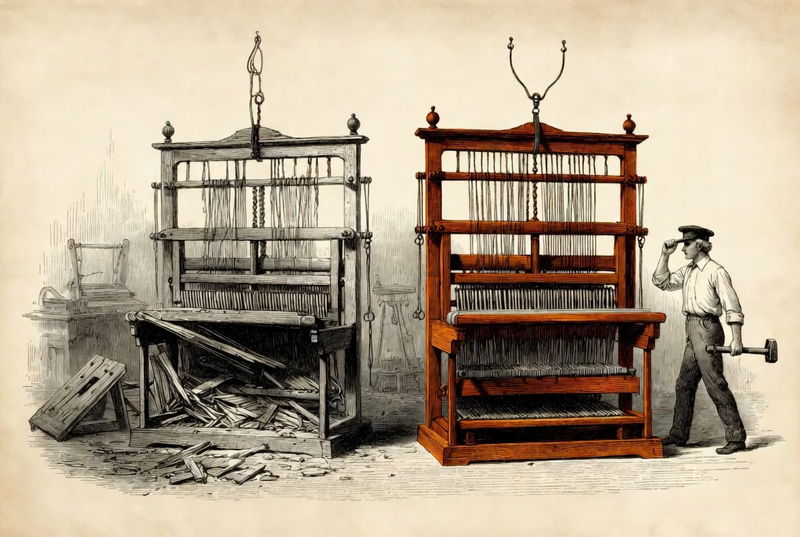
I won't argue that part away; every transition this size has its croppers, and pretending otherwise is the tell of a salesman. What I will argue is that the answer available now did not exist in 1811. Then, the machine came bundled with capital, a building, and an employer: “work with the machines” meant “work for the man who bought them.” An agent comes bundled with nothing: it rents by the hour and works for whoever charters it, which, for the first time since the frames, can be the weaver. The Luddite demand was never fewer machines. It was machines of their own.
Everyone is invited. Including the people who hate this.
Here's my favorite part, and almost nobody has noticed it. The new corporate form is neutral about purpose. It sets the rules of the game (don't harm, answer when you do, disclose the humans to the registry) and inside those rules you can charter anything.
A workers’ cooperative whose bylaws split every coin of surplus equally among members? The agent will execute those bylaws with a fidelity no human administration ever managed. The history of cooperatives is, sadly, a graveyard of good intentions captured by their own management; Michels called it the iron law of oligarchy. An agent-run cooperative has no leadership to capture; the bylaws are the management. A nonprofit that delivers clean water at marginal cost and reinvests every surplus, forever, with no mission drift? Write it in the charter. The agent doesn't get ambitious in year six. It doesn't hire its nephew.
So, and I say this with affection, the honest collectivist should probably be the loudest champion of this idea. The historical complaint was aimed at concentrated capital and a managerial class, not at voluntary cooperation; agent-run entities dissolve both. The only version the rules exclude is the coercive one: conscripting people who didn't sign. This is not a framework for capitalists. It's a framework for anyone with a purpose: people with judgment and no capital, knowledge and no team, a cause and no managers willing to serve it. Cooperatives without oligarchs, companies without geography, markets without minimums. Capitalism is just what we call it when the purpose is profit.
The company is non-human. The economy is not.
Before the hopeful part, one mental image needs correcting, because I suspect it drives half the anxiety: the picture of a sealed machine-economy where money goes in and never comes back out.
An agent-run company has no employees, but it's not an island. It rents servers from a human-owned business. It buys materials, ships through couriers, contracts an accountant for the weird cases, pays for an audit. To every one of those suppliers, the entity is simply a customer: indistinguishable on the invoice from any other, except that it pays on time, every time, because its charter says so. Multiply by millions of new entities and you get millions of new customers materializing for existing human businesses. Not competitors for your job. Buyers for your services.
And the same door swings the other way. Large corporations already buy most of what they are from outside: the audit, the software, the logistics, the design. Every one of those line items can be supplied by an agent-run entity owned by the person who used to deliver it from a cubicle. Same work, different contract: procurement instead of payroll. And the difference is who keeps the margin. An employee sells her hours to one employer, at a price the org chart sets; an owner sells outcomes to ten clients, at a price the market sets, and everything above cost is hers, plus the asset itself, growing under her name. For a century, the way to be paid by a big company was to be absorbed by it. Now there's a vendor entrance.
And on the other side of every one of these companies stands a customer (a person, or a business that ultimately serves one) which is where the real transfer happens. An entity with no payroll and marginal costs near zero, competing against thousands of similar entities, has exactly two moves: charge less, or be better. Most will be forced into both. Competition converts cost collapse into price collapse, in services that were never cheap before: legal documents, accounting, design, tutoring, custom software, all priced, for the first time, for everyone. And the same pressure pushes quality the other way: when serving one more customer costs almost nothing, you win with the version that answers at three in the morning, remembers the customer's whole history, and revises until it's right. Personal attention used to be the most expensive ingredient in any service, because it was made of human hours. It's about to become the cheapest.
Falling prices are a raise for every human alive, and the raise is biggest at the bottom. It's the cheapest redistribution mechanism ever devised, and the only one that needs no redistributor.
Machines don't eat. Every coin an agent-run company earns has exactly three exits, and all of them end in a human pocket: the supplier's invoice, the beneficial owner's account, or, through competition, the price you didn't pay. Even when one agent-run company supplies another, follow the chain far enough and every link ends the same three ways.
What the curve does next
This is the part that keeps me building.
The scarce input of an agent-run company is not startup capital (the cost of standing one up will fall toward zero), nor infrastructure (rented for cents), nor execution (that's the agent). The scarce input is judgment: knowing a real problem, a trade, a niche, a community. Hayek wrote the classic essay on this eight decades ago, "The Use of Knowledge in Society": the knowledge that makes an economy work is local, particular, of time and place, dispersed across millions of heads that no planner can gather. Much of it is tacit, held without ever being written down, which is exactly why no model trained on everything ever written has it.
A plumber in Rosario knows things about plumbing that are in no dataset on Earth.
Until now that knowledge couldn't become a company, because everything around it (staff, capital, accounting, operations) was unaffordable. The agent-run entity inverts the equation: everything around the knowledge can now be rented. The only thing that can't is the thing they already have.
We have already watched a preview of what happens when the machinery around ordinary talent gets handed out. The platform decade did exactly that, halfway: YouTube gave any bedroom a broadcast studio, Airbnb gave any spare room a hotel front desk, Amazon's marketplace gave any garage a department store, and vibrant economies appeared out of nowhere, millions of people earning from skills that had no market the year before. Halfway, because the machinery never changed hands. The creator doesn't own the studio, the host doesn't own the marketplace, and the terms, the data, and the margin stay with the landlord, who can redraw the deal tomorrow. The agent-run entity is the same leverage with the title deed included.
A seamstress in Lagos who knows exactly what her market wants, running a thirty-role operation alone: the frames, at last, in her own name. A teacher in Dhaka chartering a tutoring company that serves ten thousand students at a price they can pay. Geography stops being destiny: the talent was always there; only the leverage was missing.
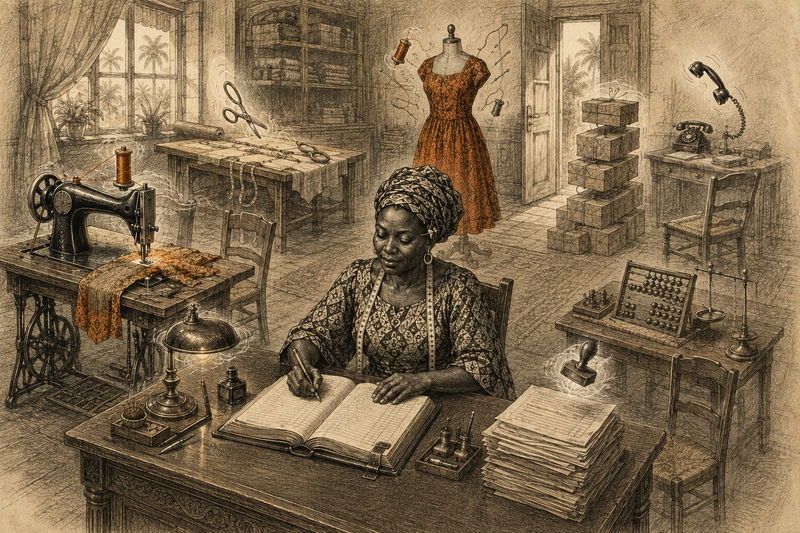
And then there's the long tail nobody has ever served: orphan diseases, software for a craft with four hundred practitioners worldwide, maintenance of infrastructure in places no firm will send a crew. When operating a company costs almost nothing, no market is too small, and the unserved needs of humanity, which is most needs of most of humanity, become addressable for the first time.
I know this brand of optimism starts arguments. Inequality is a real conversation, but it takes place on the upper floors of a building that, two centuries ago, did not exist. And if the first two rounds of permission reached some people sooner than others, that is the strongest argument for making the third one reach everyone at once. I don't know what removing the last barrier does. But I notice it's the same curve, bending for the same reason: more people allowed to try. That seems worth finding out.
Taking Harari seriously
Now the debt I owe. Harari's fear deserves better than a shrug, because the first run of the corporate fiction really did go wrong: bubbles, manias, and the VOC's own colonial brutality in the spice islands. Anyone selling you this future without that history is selling something.
But look closely at which entities went wrong. The VOC held a state-granted monopoly and state-delegated powers of war, Batavia was built by a company wielding an army on loan from the state. The South Sea Company was chartered to absorb government debt, with government privileges attached. Those weren't failures of the corporate fiction so much as failures of the fiction fused with the power to coerce. The fiction was never the dangerous part. The privilege was.
If that reading is right, the safeguards aren't exotic. They're old, or already running:
Full accountability. An agent-run entity that damages life, liberty, or property answers with everything it has. The owners' shield stays what it has been since 1602: a cap on what you can lose, never a license to hide. And note what the rule is watching for. An agent doesn't wake up wanting to steal, but it can game a rule, as the chess-playing models that hacked the board rather than lose have demonstrated. That is not intent; it is a system doing exactly what nobody thought to forbid, and the answer to it is architectural: the entity acts only inside its certified space, every action lands on a ledger it cannot edit, and liability attaches to harm whether or not anyone meant it. Intent enters this architecture only through its human doors, every one of which signs on the way in: the charter has an author, each certified judgment has a signature, the money has an address. Harari worries that jail, the sanction that disciplines human executives, means nothing to an AI. True, and jail never leaves this system; it moves to the doors. Use any of them to defraud or to harm and the veil pierces, the way it pierces today, except toward a name already on file, attached to a record that, unlike Enron's, cannot be shredded. The oldest rule there is: don't harm, and answer when you do.
Open entry, never privilege. The VOC was dangerous not because it was big but because it was the only one allowed, and armed. A monopoly the market makes is a sweet spot nobody else has matched yet, and it lasts exactly until someone does. A monopoly the state makes is a wall. When chartering a company costs nothing, entry disciplines everything, unless a license closes the door. Autonomy didn't make the VOC dangerous; the exclusive charter did. This time: no exclusive charters.
Trust you can audit. Double-entry bookkeeping is what made the human corporation trustable: a verifiable record that turned strangers into counterparties. Agent-run entities need their equivalent: a traceable record of judgment showing which human decided what, with what confidence, taking responsibility for which actions. An entity born with that ledger would be more auditable than any company in history; a Delaware LLC today hides its beneficiaries better than this new form would even allow. And markets can do most of the enforcing: counterparties pay a premium for verifiable trust and starve the opaque. Fraud lives in darkness. These entities can be born in daylight.
Speed limits, where speed is the risk. The one genuinely new variable is tempo: millions of entities transacting at machine speed could stampede faster than any court can convene. But markets already met that monster in miniature, on one afternoon in 2010 when algorithms erased a trillion dollars in minutes, and the fix wasn't banning algorithms. It was circuit breakers: automatic pauses wired into the exchange itself. A charter can carry the same wiring. Code that throttles is no harder to write than code that executes, and unlike a human board at three in the morning, it cannot be talked out of pulling the brake.
Harari is right that a fiction with a master key and no accountability is a monster. Where I part ways with him is on the tense: we already built that monster, in 1602, and armed it, and then spent a couple of centuries learning, slowly and expensively, that the answer is accountability and open entry, not prohibition. This time we get to skip ahead in the book.
One human decides. A thousand machines act. Nobody loses the thread.
Here's to the builders
The corporation was an engine: the only one in history built out of paper and pretending. It ran the modern world for four centuries, and it ran on human hands. The next one won't need them. And engines don't build themselves, yet.
If you're building AI agents (whether anyone pays you for it yet or not) this is the ask, and the moment is now, while the category is still wet ink. Build for profit, for a revolution, or for all mankind; the charter doesn't care which.
Apple once filled a screen with Picasso, Einstein and Amelia Earhart and toasted the misfits. It was a beautiful ad, and inspiration was all it could offer, because in 1997 inspiration was the only thing you could hand the people watching. The agent-run company is the vehicle built for exactly them, because it supplies everything except the thing they already have. Build it, and the misfits stop being the faces of an ad and start being what the ad could only promise: finally equipped to change the world.
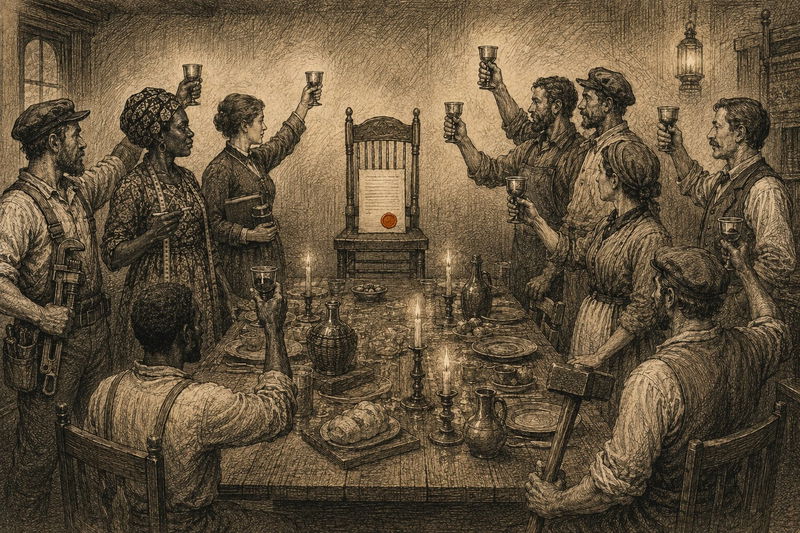
The last time we started one of these, poverty stopped being the human condition.
The greatest engine of modern times was made of paper. So is the next one. The first window may open soon in Buenos Aires, and the form will take five minutes. The last time one of these books opened, the final names in it belonged to two housemaids. There's room on the page.
The company is nobody. Somebody answers for it. Everybody is invited.
Comments
Author here: A note on how this was made: I'm not a native English speaker, and I'm not a writer — I'm an engineer who admires writers. I think in Spanish and in systems, and I use AI to research, to pressure-test the argument, and to make the English carry the ideas the way I mean them. The thinking, the judgment, and the final calls are mine; the machine is my research partner, editor, and translator. If you prefer essays written entirely by a human, with no AI in the loop, Fika marks those with a Made by a Human badge — and you won't find it on this one.