Overture
On three honest fears, a shop that shouldn’t exist, and the sound an orchestra makes before the music.
For three essays now I have been walking around the same event, looking at it from different sides. When doing got cheap — when machines learned to execute what only trained people could execute — what happens to the way we organize work? What happens to the company itself? And, closest to the bone, what happens to you, the person who spent a life getting good at something a machine now does in seconds?
This one is about what those questions left standing: the markets. The market where we sell what we make. The market where we sell our work. And the quiet market underneath both, where each generation learns its trade from the one before. AI is not a software story; it is walking through every profession at once — the lawyer, the designer, the accountant, the translator, the programmer, the doctor. And in every one of them, the same three fears are doing the rounds. You have heard them. On some days I have said them.
That the craft is dying — that the people who loved their work will have to find something else to love. That the door has closed on the young, who arrive to find the first rung sawn off. And that there is nothing much left to build or sell anyway: the interesting products exist, the interesting services exist, and the machine is here to deliver them cheaper.
My claim is that all three fears are real, serious, and old. We have lived each one before, almost word for word.
Take the first fear, the one about the craft. The strongest version I know goes something like this: it is the age of AI, in every outward and inward sense of that word. We are grown mechanical in head and in heart, as well as in hand. Not the external and physical alone is now managed by AI, but the internal and spiritual also. The keyboard drops from the fingers of the professional, and falls into silicon fingers that ply it faster.
A confession: nobody on your feed wrote that. Change four nouns back — AI was machinery, the keyboard a shuttle, the professional a weaver, the silicon fingers iron — and it is Thomas Carlyle, in 1829, watching the steam engine and the power loom manage “the internal and spiritual.” What followed his diagnosis of the mechanized soul was an extraordinary century of invention: photography, the telegraph, anesthesia, the railway, the telephone, recorded sound, electric light, the movies.
Fine, says the second fear. The loom took muscle; this thing takes minds, and this time the jobs will not come back. There is even a name for it: we are being afflicted with a new disease of which some readers may not yet have heard the name, but of which they will hear a great deal in the years to come — namely, technological unemployment. This means unemployment due to our discovery of means of economising the use of labour outrunning the pace at which we can find new uses for labour. That one I did not have to modernize at all. It is John Maynard Keynes, 1930, word for word. And here is what the people who quote him rarely add: in the very next sentence, Keynes called that unemployment only a temporary phase of maladjustment, and spent the rest of the essay predicting abundance. He was betting on my side of this argument. What he left open is the question that actually matters — how long is temporary, and who pays for it while it lasts? Hold that question. This essay owes it an answer before the end.
All right, says the third fear, but this time it really is different, for a simpler reason: the important things have been built. From here on, the machine optimizes. That conviction has a birthday too. It seems probable that most of the grand underlying principles have been firmly established, a great physicist told an audience in 1894 — and approvingly repeated another physicist’s remark that the future truths of software are to be looked for in the sixth place of decimals. One word changed: software was Physical Science. The speaker was Albert Michelson, and to be fair to him, he hedged — it is never safe, he admitted, to say no marvels remain. Then the X-ray arrived the following year, and after it radioactivity, the electron, the quantum, powered flight, relativity. Even Michelson underestimated how much of the map was still blank. One of the experiments that would help open it was already his own.
I spend my weeks helping organizations adopt AI, and I keep meeting these three fears in two costumes — hurry and paralysis — wearing the same belief underneath: that the interesting things already exist, and the machine’s only job is to do them cheaper.
So let me say plainly what I think — it fits in four sentences — and spend the rest of this essay earning them.
I think this is a very good moment to be senior at your craft.
I think the young are not doomed; they will form differently than we did, and the surest way to ruin them is to turn them into operators of a machine they never question.
I think the map of viable markets is expanding even as many existing ones grow brutally more crowded, and the durable opportunities are moving one layer down.
And I think the feeling that everything has already been invented is not a conclusion but a symptom.
The mechanism behind those four sentences is not mysterious, and I would rather state it than smuggle it. When the cost of executing falls, supply explodes. When supply explodes, the scarce things move: to being found, being trusted, being verified, being answered for. And problems that never justified their price come suddenly within reach. That is the whole engine. History cannot prove it will run the same way this time — analogies illustrate; they do not demonstrate. What history can show is how the engine has run before, and what it felt like from inside. Which is why we should talk about watches.
What the watchmakers know
There is a shop in Geneva that will sell you a forty-thousand-dollar machine that does its one job worse than the free clock on your phone. The shop is not struggling. For some pieces, the waiting list runs to eight years.
It shouldn’t exist. In 1969, Seiko shipped the first quartz wristwatch; it kept better time than the finest mechanical movement ever built, and within a generation that accuracy cost less than the box it came in. Switzerland lost two of every three watchmaking jobs. By every rule of utility, that was the end.

Then the obsolete machine came back, and it came back expensive — because somewhere along the way, keeping time quietly stopped being what a watch was for. The industry quartz “killed” set an all-time export record in 2023 and still ships roughly twenty-five billion francs a year. Bookstores tell the same story: Amazon won on inventory and price, and the independents that survived grew back selling curation and company instead.
The machine takes the utility, and the craft comes back for the meaning. But the lesson is narrower than it looks: it proves a craft can outlive its usefulness by becoming meaning, not that every displaced job returns — the two-thirds of Swiss watchmakers who left in the seventies mostly did not come back to benches.
The customer moves upstream
Now look at the market for goods and services, because something structural is shifting in who does which part of the work.
A mother whose son had spent years in undiagnosed pain finally fed his history into a chatbot, which pointed to a rare spinal condition; a neurosurgeon confirmed it and operated. She did not replace the professional — she walked upstream into work that used to be his: the reading, the cross-referencing, the hypothesis. What she brought him was the part she could not supply herself: clinical judgment, a decision, and someone who answers if it goes wrong. The signature on the surgical consent is shorthand for that last thing, and it is one of the least reducible things professionals sell: not reassurance but recourse — the license, the liability, the standard of care behind the name. AI can make an answer cheap without making responsibility cheap. Versions of this transaction are appearing in every trade — the homemade contract brought in for review, the shop owner’s homemade app. Worse than the professional version, radically cheaper, loved the way only homemade things are loved, and still needing, at the end, a person who stands behind the outcome.
Meanwhile the making itself is flooding. One games platform received nineteen thousand new titles last year; nearly half received fewer than ten user reviews, and versions of that flood are arriving in books, music, and design. A founder I know compressed the new economics into one line, replying to a post about how hard it is to run AI agents for thousands of users: “One of the hardest is to get those thousands users.” It has never been cheaper to make things. It has never been more expensive to be found making them.
That is not the death of selling; it is the relocation of it. For every task the customer absorbs, the markets underneath multiply — the tools, the platforms, the guarantees, the certified knowledge that decides whether homemade work can be trusted with things that matter. (Building in one of those layers is my own work these days, so discount my enthusiasm accordingly.)
When making gets cheap, being believed becomes the business.
The library between them
The labor market is where the tremor is sharpest, and I won’t sweeten it. Since 2022, employment for the youngest workers in AI-exposed occupations has fallen roughly a fifth relative to their less-exposed peers — driven primarily by reduced hiring rather than layoffs, and the authors are careful to call this early, descriptive evidence. For centuries, beginners were paid to do the routine work, and the routine work secretly paid them back: it was where judgment formed. The machine absorbed exactly that work. We unscrewed the bottom rung of the ladder and called it efficiency.
Now put the strangest fact of this moment next to that one. The same Stanford data carries a clue about what, exactly, the machine absorbed: the declines concentrate where a job runs on codified knowledge — the kind that got written down — while experienced workers have held up better where the work leans on tacit knowledge, the kind acquired only through practice. The machine did not take the young mind or the old one; it put the written-down part of every trade behind an interface cheap enough to consult in seconds. And in one of the first large field studies of this technology at work — 5,179 customer-support agents — the gains went overwhelmingly to the least experienced, roughly a third improvement, while veterans barely moved. Similar patterns have shown up among consultants and writers. The machine lends a beginner, on day one, the bookish half of experience.
Hold both facts at once, because together they are the paradox of this decade:
AI makes the beginners who get in dramatically better — while the labor market is simultaneously finding room for fewer of them.
I will not pretend to resolve this cleanly, because I can’t. A rational firm, quarter by quarter, has little reason to open the door: a senior with the machine can cover work once spread across several juniors. The only honest answers I have are partial. Deposits deplete — every senior is a former beginner, and an industry that stops admitting beginners is running down a stock that appears on no balance sheet; and that stock is not a bill any single firm volunteers to pay. What I can offer is a precedent with my fingerprints on it. The last time a consequential machine got cheap enough to own, formation did not wait for anyone to organize it. Programming entered the world’s houses as a hobby, not a career: kids typing games out of magazine listings into computers bought for Christmas — unpaid, unsupervised, unaccredited. When Bill Gates complained in 1976 that people were copying his software, the letter was addressed, literally, to hobbyists — that is mostly who computing was. I was one of them, formed by manuals and magazine listings one crash at a time.
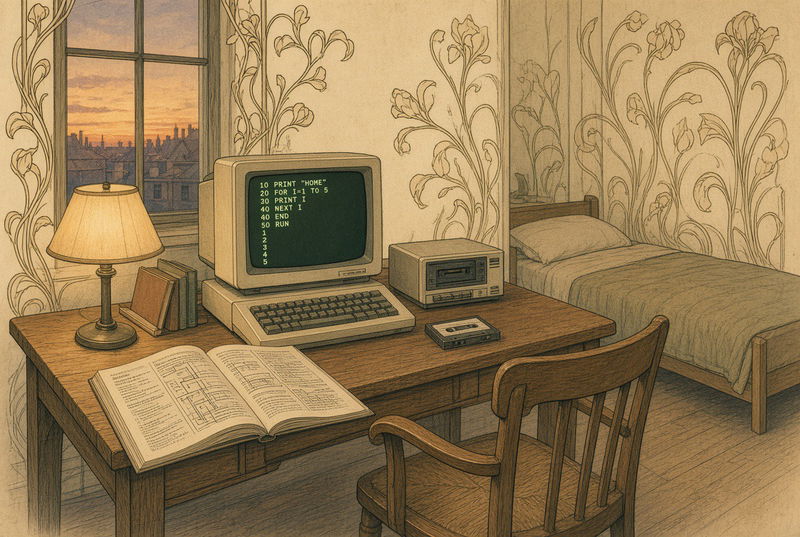
For a generation of programmers, formation partly decoupled from employment: people arrived at their first paid work having already spent years making things nobody had hired them to make. Nobody promises the sequel — the eighties had a boom hungry enough to absorb every bedroom, and this decade owes nobody a boom. But the direction is open again: the machine that absorbed the beginner’s paid work is also perhaps the cheapest formation device ever built, and this time it does not even need the bedroom — it fits in a pocket, including the pocket of the beginner nobody is hiring yet. It cannot hand you a licensed signature — medicine and law keep their doors — but it can put you in the loop where judgment forms: your project, your crash, your fix.
Chess is useful here not because it proves what AI will do to work — it is a game, and games forgive what labor markets do not — but because it separates assistance from consequence unusually cleanly. When engines surpassed humans, the game did not empty out. The engine became the training partner; the tournament stayed the tournament: you still sit down alone and lose by yourself. Formation compressed because consequence was preserved. That is the portable lesson, and it is exactly what we break when we turn a beginner into an operator who ships whatever the machine says.
The pattern is even moving indoors. A veteran engineer who pushed back hard on my last essay, in public, has built the professional version of that bedroom behind his company’s firewall: twenty years of scars deliberately encoded into a simulated deployment environment where his junior trains — practice compressed, real deploys kept real — plus a weekly hour of the experience no simulator holds. His first-year engineer, he says, already outruns some ten-year veterans on this work, and covers what once took a small team: the paradox again, not its solution. But mature answers have always started like this — as somebody’s workshop.
Where crafts go
The grief of the experienced deserves the most respect, because its honest version is not fear. A founder I admire wrote recently that craft is dead — that people like him, who went to bed thinking I can’t believe I get paid to do what I love most, need to rethink their careers. That is not anxiety about employment. It is grief for the paid home of a loved thing, and versions of it are being felt this year by architects, illustrators, translators, radiologists, and engineers alike.
What the record shows is stranger than either doom or comfort: crafts and their paychecks part ways, and the crafts persist. The watchmakers you have already met, and Bach is coming. Whether your mortgage can live on meaning is a fair question, and it belongs in the bill below.
But be careful about what exactly a veteran still owns, because it is not knowing more things. Much of what took decades to accumulate — the syntax, the case law, the known failure modes — is codified, and the machine now rents it to anyone. What resists is the part that never got written down: when the standard answer does not apply, what will break in six months, which risk to accept, what you are willing to sign. Hayek had a name for that part in 1945 — the knowledge of the particular circumstances of time and place — and argued it never exists in concentrated form. He was writing about planners, not machines, but the distinction survives: that part is still not in the model. That earned judgment keeps appreciating with age, and you would expect labor markets to reward it. Often they don’t.
There is an evening from 1747 that I think about often. Frederick the Great, King of Prussia, was a thoroughly modern monarch: a flute-player who collected the latest of everything, including several examples of a brand-new machine called the fortepiano — the ancestor of the piano, the gadget of its day. The old organist he had summoned to court, Johann Sebastian Bach, was by then considered a relic; fashionable critics had spent a decade calling his intricate, many-voiced music a thing of the past, and even Bach’s own sons, employed by the king, composed in the lighter style the court preferred. The king sat the old man at the new machine and played a theme of his own invention — long, chromatic, unusually difficult to build on — and asked him to improvise a fugue on it: several melodic lines, all built from that theme, all unfolding at once, invented in real time. It is the musical equivalent of solving a chess problem while composing the poem that describes it. The sixty-two-year-old put his hands on a keyboard he had never owned and did it on the spot. Then he went home and mailed the king the Musical Offering, the challenge converted into a masterpiece. Forty years at full power on the newest machine in the room — and what carried the evening was not stored knowledge, which any library already held, but the judgment those years had become. Books and calculators have always lent us pieces of ourselves; what is new is the degree: the codified part of competence now rents at conversational speed and negligible cost. The part earned the way Bach earned his is much harder to rent.
The bill
Every optimism owes a bill. The last essay conceded the grief; this one owes the price. Here it is, in full.
New value can appear and millions can still lose. A craft can survive while the salary that funded it disappears — telling a fifty-year-old that his skill now lives on as meaning does not pay his mortgage. The new professions may arrive, but not in his city, not for his cohort, not at his wage; the weavers Carlyle worried about were not wrong for their own lifetimes; economic historians call it Engels’ pause — the decades in which output per worker climbed while real wages barely moved — and the worker living through it would not have been consoled to learn the graph turns up eventually. The pie can grow while its ownership concentrates. Beginners who get in can be extraordinary while far fewer get in. That is Keynes’s unanswered question — how long is temporary, and who pays? — and the honest answer is: longer than a career can afford to wait, and mostly the people least positioned to absorb it. Transfers can soften who pays; they cannot, by themselves, end the disease. By Keynes’s own definition, it lasts exactly as long as our discovery of new uses for labour keeps lagging our economising of it. New uses are not decreed into existence: they are found, financed, built, adopted — and the finding is the step nothing can replace. Some of that finding, last time, happened in bedrooms, by people nobody was paying to look. The flood is real too: half of nineteen thousand titles sinking unseen is not a renaissance, it is a slush pile, and the layers that should filter it are still more promise than industry. Nor is every era that feels finished a hidden dawn; some maps really do close — ask the draft horse, or the linotype operator — and no analogy in this essay can prove which kind ours is.
And still — accepting every line of that bill — I believe the four sentences I opened with. Not as theorems. As bets, placed with open eyes, on a pattern that has held before:
abundance in one dimension tends to expose scarcity in another.
Nothing in that promises the transition will be fair; the bill above says it will not be. The bet is narrower — that there will be things worth building, and people needed to build them.
The shops that couldn’t exist
Because there is a second kind of impossible shop, and its shutters are going up right now. The first kind shouldn’t exist by the logic of utility, and thrives. The second kind couldn’t exist by the logic of economics — until the price of trying collapsed.
A doctor who nearly died of a rare disease identified an old transplant drug that had never been used against it — it has kept him in remission for years — and now runs the search the industry never ran: every approved drug against every known disease, a search that stayed undone for decades because off-patent medicines reward no one for testing them — and that runs today on philanthropy, because cheap tools lowered the cost of trying without repairing the incentive. A Māori community radio station, tired of waiting for big tech to care about their language, built its own speech recognition with three hundred hours of speech volunteered in ten days — and kept it under Māori stewardship.
Behind these counters: a patient and a radio station. Not the establishment. So far, the frontier is being taken mostly by people the establishment had no category for.
Seeing
So what becomes scarce, when executing is nearly free? Seeing. Noticing which problems around you are still solved the old way out of pure habit. The parents who built the remote glucose-monitoring tools that manufacturers had not built — their hashtag was, magnificently, #WeAreNotWaiting — saw one. It is the same muscle in every trade. Stop asking how do I execute and start asking what here is quietly absurd.
If a twenty-two-year-old asked me what to do for the next twelve months, in any field, that would be my answer: find something absurd, re-solve it with the machine, ship it, and sign it. The signing is not decoration. Judgment forms where consequence lands on you, and nobody has repealed that. If nobody will let you sign yet, make that the goal: get somewhere your errors have consequences and an owner. Whatever the machine compresses, the scar tissue still arrives at one year per year: a design that rots in eighteen months takes eighteen months to teach you it rots.
The century that answered
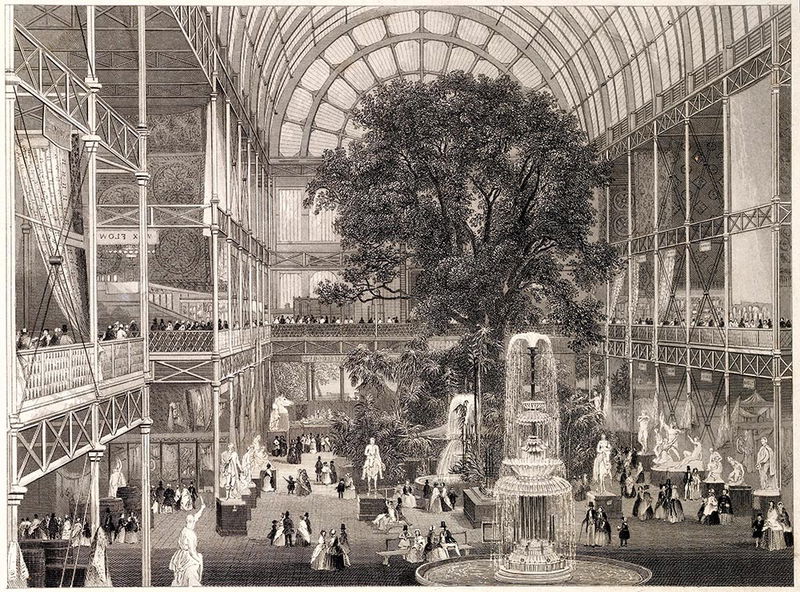
Carlyle published his diagnosis of the mechanized soul in 1829. Everything listed at the top of this essay — the photograph, the telegraph, anesthesia, the light — arrived in the decades that followed, and in 1851 the century gathered its wonders under a palace of glass in London and invited the world to walk through them. The age of machinery, in every outward and inward sense, turned out to be the age in which astonishment became an industry.
Michelson announced the sixth decimal, and the X-ray arrived the following year. Keynes named the disease and called it temporary; the abundance he predicted did come — and temporary has never meant painless to the people living through it. None of these fears were foolish. The weavers really did lose the looms; every age has a bill, and I have tried to price this one honestly. So if you are afraid right now — for your craft, for your start, for your shop — you are not misreading the moment. The fear can be right about the scale of what is coming and still wrong about its final shape.
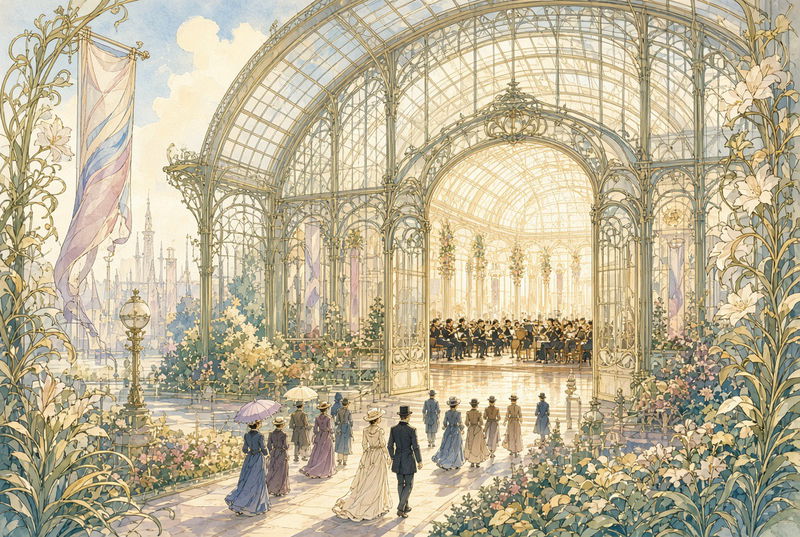
Because there is a sound an era makes when it turns, and we all know it from the concert hall. Before the music, the orchestra tunes: a minute of overlapping noise, every instrument testing itself in the dark, and from the seats it is indistinguishable from chaos. That is not the show falling apart. That is the show about to start.
What you are hearing is not a finale. It is an overture. And if what you fear losing is the craft itself, then there is already an instrument in your hands.
Bring your instrument.
Comments
No comments yet. Be the first to comment!